

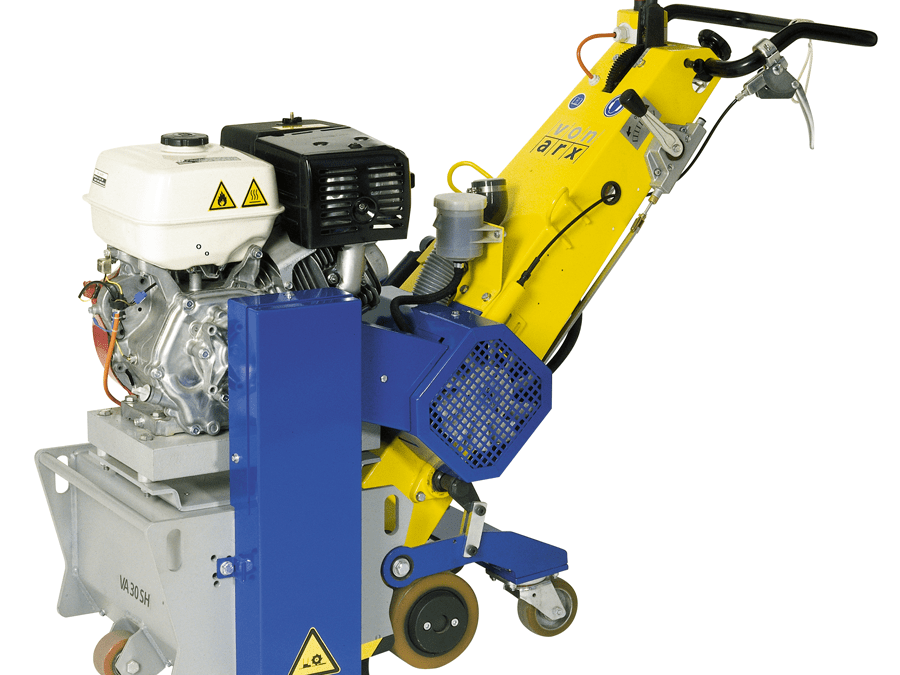
Scarifiers earn their place on job sites because of their flexibility and versatility. You can use a scarifier to grind off old coatings in the morning, then switch it out to level a slab that afternoon.
Learning how to use a scarifier effectively comes down to understanding the machine and pairing it with the right cutters. When you master these fundamentals, scarifiers can save serious time and deliver superior results.
VonArx scarifiers are especially tough and built for demanding prep work. They give you control, cutting power, and surface consistency that other equipment can’t always match.
What Is a Scarifier and How Does it Work?
A scarifier (also called a surface planer or milling machine) is a powerful tool designed to remove material from concrete or asphalt surfaces using rotating drums fitted with cutting tools.
In surface preparation, scarifiers are the workhorses for quickly removing unwanted coatings or imperfections. They excel where grinders or chemical strippers fall short.
So, what is a scarifier in more technical terms? It’s a machine that spins a drum lined with interchangeable cutters at high speeds, flailing into the surface to break it apart. This action creates a textured finish with depth that can be precisely controlled, ideal for removing thick coatings or exposing aggregate.
Scarifiers also excel at applications where the bonding performance of new overlays or coatings depends on profile roughness.
When Should You Use a Scarifier?
Not every project calls for the aggressive approach of a scarifier, but when speed, depth, and material removal are critical, scarifiers shine. Use a scarifier when you need to:
- Remove concrete layers, epoxy coatings, adhesives, and other high-build materials
- Correct uneven surfaces and improve traction
- Prepare substrates to ensure optimal adhesion of coatings or overlays
The depth of cut and impact profile can be fine-tuned using different cutter types and adjustable drum settings, giving operators flexibility to remove just the top layer or dig deeper into the slab.
This control allows you to meet specifications for everything from coating prep to creating grooved, high-traction finishes.
Common Scarifier Applications
Scarifiers adapt to real-world uses across various industries, from airfield maintenance to retail buildouts. The three most common applications include:
Coating Removal
Scarifiers remove stubborn coatings such as epoxy, urethane, or elastomeric membranes faster than grinders or shot blasters.
Perfect for removing:
- Paint and epoxy coatings
- Adhesive residue
- Traffic lines and rubber deposits
- Plastic coatings and dirt crusts
Leveling Uneven Slabs
Scarifiers can shave down high spots or transitions in slabs, eliminating trip hazards and preparing floors for overlays.
Creating Textured Surfaces
For environments requiring traction (loading docks, ADA-compliant walkways), scarifiers create controlled surface texture finishes.
Additional scarifier uses include:
- Concrete grooving for anti-slip ramps and sidewalks
- Correcting concrete joints and lippage removal
- Fast aggregate exposure through concrete stock removal
- Substrate preparation for decorative finishes or broadcast systems
Get to Know Your Scarifier’s Various Uses
Scarifiers are usually one of the first tools you use in preparing your surface for coating or installation. While some surface prep equipment and machinery have a single purpose, scarifiers stand out in that their applications will vary depending on your needs. Typical applications for scarifiers include:
- Removing coating, epoxy, and glue
- Concrete grooving for anti-slip on-ramps and sidewalks
- Correcting concrete joints
- Lippage removal
- Eliminating trip hazards
- Concrete stock removal for fast aggregate exposure
- Removing traffic lines, rubber deposits, dirt crusts, and plastic coatings
Scarifiers can also be used to prepare substrates for decorative finishes or broadcast systems by giving installers more control over texture and profile.
Of course, adjustments should be made if you’re hoping to take advantage of the scarifier’s multi-purpose nature. While not every scarifier is capable of all the above uses, many are able to adapt for a variety of demands – you simply need the right cutters.
Choosing the Right Cutter
Success with scarifiers depends heavily on selecting the proper cutters. You’ll need to change attachments based on your specific application, as cutters are manufactured for different surface impacts.
VonArx offers three main cutter types:
- Carbide (Pentagonal, Octagonal, Hexagonal, Bihexagonal): Feature tungsten tips for roughening concrete and asphalt while removing old coatings
- Beam: Designed for removing road markings and paint from asphalt and concrete, ideal for large steel structures or materials requiring minimal surface structure changes
- Milling: Specialized for removing and stripping thermoplastic and cold plastic coatings and markings
Expert tip: Many scarifier drums allow for an easy switch from cutter to cutter, adding versatility to your work. That said, you can only get so far in your investment without the right scarifier model.
How to Use a Scarifier Safely and Effectively
Proper scarifier operation goes beyond powering on and pushing forward. Success depends on setup, material type, and jobsite conditions, all affecting safety and effectiveness.
Pre-Operation Setup
- Inspect your equipment: Check the scarifier’s drum, cutters, and fasteners
- Verify safety features: Ensure all guards are in place
- Clear the work area: Remove debris and hazards
- Start with test settings: Begin with depth adjusted to a test level—you can increase cut depth after assessing surface results
Operating Technique
- Run smooth, overlapping passes while maintaining consistent forward motion
- Avoid lingering in one spot to prevent gouging or over-cutting
- For large surfaces or varied elevations, use a self-propelled model with precise depth control to save time and reduce operator fatigue
PPE and Operational Safety Notes
A scarifier generates dust, debris, and vibration. Protecting yourself and your crew is not optional; it’s essential. At a minimum, PPE should include:
- Eye protection (ANSI-approved)
- Hearing protection (scarifiers are loud)
- Respirators or dust masks rated for silica
- Gloves with vibration protection
- Steel-toe boots
Additionally, always pair your scarifier with a proper dust extraction system to minimize airborne silica exposure. Consider pre-wetting the surface or using a HEPA vacuum system compliant with OSHA standards.
Training new operators on proper use and emergency shut-off procedures is also key. Runyon Surface Prep offers product training for those new to operating heavy-duty surface prep equipment.
Scarifier vs Grinder
The debate of scarifier vs grinder comes down to impact. Grinders use diamond tooling to abrade the surface for polishing or minor prep gently. Scarifiers, by contrast, use rotating cutters to chip and remove concrete or coatings physically. The result is a more aggressive texture and greater material removal per pass.
Choose Scarifiers For:
- Fast removal of thick coatings
- Leveling uneven concrete
- Deep profiling for overlays
- Aggressive material removal
How they work: Scarifiers use rotating cutters to chip and remove concrete or coatings physically, resulting in aggressive texture and greater material removal per pass.
Choose Grinders For:
- Polishing and honing
- Removing thin coatings or adhesives
- Smoothing and finishing after scarifying
How they work: Grinders use diamond tooling to abrade surfaces for polishing or minor prep work gently.
Many contractors will use both tools in stages – scarifiers to break the surface, grinders to refine it. Understanding when to use each is key to workflow efficiency.
VonArx Scarifiers
With our line of Von Arx scarifiers, Runyon Surface Prep carries push and self-propelled models powered by gas or electricity. From power output to width of surface coverage, the capabilities of these unique models vary quite significantly. Typical models are:
VA10 Electric Scarifier
- Cutting width: 4″
- Weight: ~50 lbs
- Power: 1.5 HP
- Best for: Less demanding projects, garage installations, small rooms, hard-to-reach areas, and edge work
- Ideal applications: DIY-friendly projects or commercial touch-ups
FR200 Scarifier
- Cutting width: 8″
- Surface depth: Up to 1/10″
- Power options: Gas or electric (110V/230V with 2HP or 3HP motors)
- Features: Quick cutter switching (takes just minutes)
- Best for: Small to medium-sized surfaces, general contractors seeking portability and ease of use
VA25 S Scarifier
- Cutting width: 10″
- Power options: Gas or electric
- Features: Vibration absorber, infinite variable depth adjuster
- Best for: Medium to large surfaces requiring consistent surface removal
- Advantages: Highest level of user comfort and efficiency for commercial applications
VA30S & VA30SH Heavy-Duty Scarifiers
- Cutting width: 12″
- Surface depth: Up to 1/3″ of hard surface
- Features: Variable depth adjusters, vibration absorption systems
- Power options: Gas or electric
- Models: VA30S (push unit) vs VA30SH (self-propelled with hydraulic traction)
Choosing the Right Scarifier for the Job
With multiple sizes, configurations, and cutting tools available, choosing the right scarifier depends on your job’s size, material, and surface condition. Smaller machines work well for confined spaces or detail work, while self-propelled models increase production on larger projects.
Ask yourself:
- What material am I removing?
- How much surface area needs to be covered?
- Is power access limited?
- Will I need to adjust depth frequently?
At Runyon Surface Prep, we help you select the best Von Arx solution for your workflow. Whether you’re resurfacing a warehouse or prepping concrete stairs for coatings, we can match your application to the right machine.