

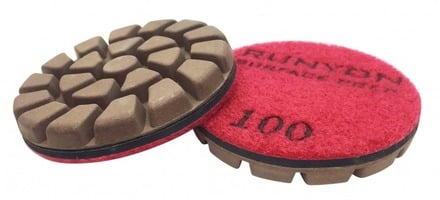
As is typical of most abrasive equipment and accessories, the effectiveness of your grind or polish relies heavily on the quality of your attachments. Yes, the variations in the grit of tooling will make a difference in the fineness of the grind.
But some tools of the same grit are better than others for different circumstances. This is because of the quality and type of material built into the tool.
Higher-quality diamond tooling solutions can significantly improve efficiency, reduce labor time, and provide a consistent surface finish.
Tooling Grit and Surface Exposure Class
First, let’s talk a little about grit. The most influential factors in choosing the right tool grit are the hardness of the concrete and the level of polish (or coarseness) of the finish you’re aiming for.
Very hard concrete, for example, will require extra soft-bond diamonds – whereas soft concrete will require hard-bond diamonds. Selecting the incorrect grit or bond hardness can lead to inefficiency, excessive tool wear, or surface damage.
Another critical consideration is diamond concentration. Tools with a higher concentration of industrial diamonds provide better cutting efficiency and a longer lifespan. This leads to fewer tool changes and a more uniform finish. Conversely, lower-quality tooling often has fewer diamonds, requiring more passes and increasing overall job time.
Surface Exposure After Polishing
There are three primary classes denoting surface exposure after grinding and polishing operations. The exposure levels are also known as Cement Fines (Class A), Fine Aggregate (Class B), and Coarse Aggregate (Class C).
Each class is separated by the percentage of surface material exposed, as follows:
| CLASS | NAME | SURFACE EXPOSURE (%) |
| A | Cement Fines | 85 – 95 % Cement Fines
5 – 15 % Fine Aggregate |
| B | Fine Aggregate | 85 – 95 % Fine Aggregate
5 – 15 % Blend of Cement Fines and Coarse Aggregate |
| C | Coarse Aggregate | 80 – 90 % Coarse Aggregate
10 – 20 % Blend of Cement Fines and Fine Aggregate |
Achieving a specific surface exposure level requires careful tooling selection. For instance, coarse grinding with a lower-grit metal-bond tool is essential when exposing large aggregate. Higher-grit resin bond tools are necessary for finer finishes. Using subpar tooling may result in uneven exposure, inconsistent scratch patterns, or excessive material removal.
Achieving consistent surface exposure requires the right grit selection and a commitment to high-quality tooling for durability and precision. Lower-quality tools can lead to uneven finishes and premature wear, whereas dynamic diamond tooling optimizes results and efficiency.
Diamonds Can Differ from Tool to Tool
Once you’ve determined what grit(s) you need for your project, the next step is understanding how tooling quality affects performance. The grit class will give you the size of diamonds in your tooling and, indeed, will associate with how fine the grind will be. But grit alone does not determine performance – the diamond concentration and bond matrix are just as crucial.
One manufacturer, for example, may supply the same grit tool as another, but their tool may consist of half as many diamonds – a cheaper alternative that may cost you in the long run.
Lower-quality tooling tends to wear faster, require more frequent replacements, and can even cause unwanted scratching, leading to additional refinishing work.
Investing in premium diamond tooling solutions results in greater precision, reduced labor time, and consistent results. Understanding and selecting the right tooling is key to optimizing surface preparation.
Types of Diamond Tooling
Different tools are made of different materials or combined with different materials, serving a range of purposes. Typically, tooling will consist of the following:
- Resin Bond: for polishing and light grinding and used with wet or dry resin tools.
- Metal Bond: for a wide range of concrete floor grinding needs.
- Transitional: often hybrid-style tools that provide cutting and grinding effects.
- Polycrystalline Diamond: affordable yet offers an extended lifespan; these are made of synthetic diamonds and may be used to remove glue, mastic, and other coatings.
Not all tooling is created equal. The choice between bond types, diamond concentration, and grit level determines how efficiently you can process the surface. A well-matched tooling system minimizes downtime and prevents premature tool wear, making it a smart long-term investment.
Concrete Surface Tooling and More at Runyon Surface Prep
At Runyon Surface Prep, we aim to be your one-stop shop for everything concrete surface prep. Between our wide spectrum of diamond tooling solutions and dynamic equipment catalog, we have what you need to get from point A to point Z.
Looking for diamond tooling? We also offer magnetic preload systems, which make for an easy switch-out of tooling attachments on power trowels, auto scrubbers, and swing machines.