

Prepping for an overlay or sealer? Getting the wrong surface profile can be a costly mistake. To bond properly with the material, the concrete needs a precise—and consistent—texture across the surface.
Our surface profile guide can assist you in finding the adequate CSP for your project. Read on to learn more about coordinating diamond tooling and machinery as well.
What Is Concrete Surface Profile (CSP)?
A surface profile of concrete or asphalt is a number associated with the material’s desired roughness or texture and its general appearance. It helps determine whether the surface is fit for a specific purpose. More specifically, the proper CSP for a surface is just as vital for adhesion as it is for the concrete’s traction.
Roughness can be an indicator for:
- Wear-ability
- Friction coefficients
- Performance in terms of cracks or corrosion
- Adhesive properties
Concrete Surface Profiles (SP1-SP10)
The lower the surface profile (SP) number (SP1), the flatter the surface. An SP10 rating is an extremely rough surface. An accepted definition of surface profile is “the average distance from the peaks to the valleys of the surface, as seen through a cross-section of the prepared substrate.”
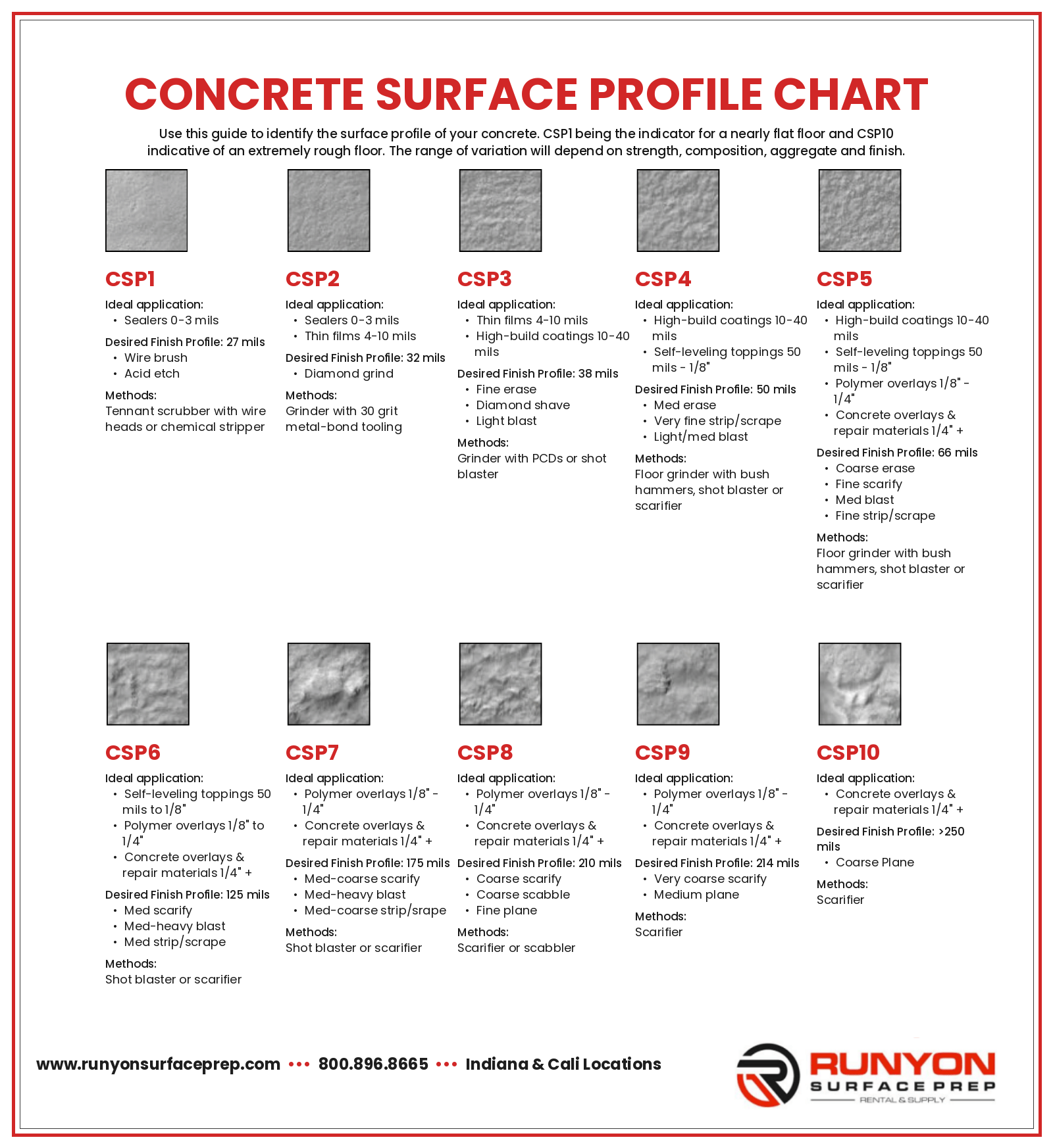
The range of variation with your specific surface material depends on its strength, composition, aggregate, and finish. A Mohs hardness scratch test can confirm the slab’s hardness rating before you begin.
The final surface must allow for the secure mechanical bond of any sealer, coating or marking material. So make sure the surface is free of any dirt, oils, and coatings before creating your desired surface profile.
Understanding ICRI & Industry Standards for CSP
The International Concrete Repair Institute (ICRI) is the organization that sets the standards for surface profiles. The ICRI was formed in the late ‘80s after contractors voiced frustration over inconsistent standards.
The ICRI Guideline 310.2R defines specific profile requirements for sealers, coatings, polymer overlays, and concrete repair. Contractors rely on these guidelines to avoid coating mishaps.
How Surface Profiles Are Measured
To verify CSP, professionals use physical CSP chips and digital profilometers to ensure profile precision. It’s a vital step in ensuring adequate surface roughness while using grinders, scarifiers, and shot blasters.
With CSP chips, you’re using visual and tactile comparison. Digital profilometers, on the other hand, provide precise measurements using an optical sensor that scans the surface. If you’re looking for the exact number, a digital profilometer is far and away the better choice.
Matching the Right Surface Prep Equipment to Your Target SP
The equipment you need will depend on its current state (coated, brand new, aged or worn) and final roughness overall. Here’s how equipment typically aligns with surface profile:
- CSP 1–3. Grinders are for low to mid-range roughness profiles. With a variety of diamond tooling, they can efficiently achieve CSP 1 to 3. You can also go with a wire-head scrubber or a chemical stripper.
- CSP 3–6. For a controlled, middle-ground profile, look to shot blasters to achieve CSP 3 to 6. Shot blasters are versatile and great for removing coatings across larger areas. They’re also low-dust. Grinders with bush hammers may also achieve this mid-range roughness.
- CSP 5–10. Scarifiers are consistently used for roughness profiles around CSP 5 and through CSP 10. Scabblers also have success in this range.
Quick Reference Guide
| CSP | Ideal Application | Equipment |
| 1 | Sealers | Scrubber |
| 2 | Sealers, thin films | Grinder |
| 3 | Thin films, high-build coatings | Grinder, shot blaster |
| 4 | High-build coatings, self-leveling toppings | Grinder, shot blaster, scarifier |
| 5 | Self-leveling toppings, polymer overlays, concrete overlays/repair | Grinder, shot blaster, scarifier |
| 6 | Polymer overlays, concrete overlays/repair | Shot blaster, scarifier |
| 7 | Polymer overlays, concrete overlays/repair | Shot blaster, scarifier |
| 8 | Polymer overlays, concrete overlays/repair | Scarifier, scabbler |
| 9 | Polymer overlays, concrete overlays/repair | Scarifier |
| 10 | Concrete overlays/repair | Scarifier |
For use in surface preparation, Runyon Surface Prep carries a full line of:
- HTC, Husqvarna, and CPS grinders
- Edco scarifiers and scabblers
- National floor scrapers
- Diamond tooling
- Carbides
- Scrapers
- Shot blasters
Why Getting the Profile Wrong Could Cost You
Seasoned contractors know that the wrong surface profile can lead to major setbacks. Getting “close enough” simply won’t cut it. Poor results show up in the job cost.
- Too smooth: If the surface is too smooth, the coating or protective sealer has nothing to grip. Adhesion failure means starting from scratch, which costs time and money.
- Too rough: When you have a surface that’s too rough, you make up the difference in added material, wasting coating costs. Over-profiling can also lead to microcracks as well, potentially damaging the slab itself.
For a precise profile and successful job, prepare the surface well by clearing it of liquids and debris and ensure the right depth with a profilometer as you develop the surface.
FAQs
What are the characteristics of a CSP 1-3 concrete surface profile?
Developed by light grinding or through acid etching, this range is nearly flat to the naked eye. It’s a lightly textured surface that’s best for applying sealers or thin coatings.
What is the purpose of a CSP 3 concrete surface profile?
The mid-range texture of a CSP 3 surface is usually intended for epoxy, polyurethane, and coatings applied at a moderate thickness.
Is concrete roughness scale the same as CSP?
Yes. Both CSP and “concrete roughness scale” refer to the same system of ratings. You’ll often see them used synonymously.
What happens if I overwork the surface?
If you end up with a CSP higher than your set rating, you’ll likely need to apply more coating to compensate.