

An industrial vacuum for concrete floors has the power, efficiency, and filtration needed to handle heavy-duty cleaning jobs. This article explores the primary factors to consider when choosing the best vacuum for concrete dust, including power, filters, size, and more. We’ll compare top-rated models and help you make the right investment for your surface prep needs.
Why An Industrial Vacuum for Concrete Dust Matters
Concrete floors are exposed to a lot of wear and tear in industrial settings. Dirt, gravel, sawdust, metal shavings, and other industrial waste can accumulate in a matter of weeks, causing abrasion and reducing the surface’s lifespan.
Key advantages in buying the best vacuum for concrete dust:
- Reduces silica exposure up to 99.97% with proper HEPA filtration
- Increases productivity compared to manual cleaning methods
- Extends concrete floor lifespan by preventing abrasive buildup
- Ensures OSHA compliance for silica dust control
Moreover, if not adequately addressed, concrete floors are prone to moisture, leading to mold and mildew growth. The porous nature of concrete floors also makes them more challenging to clean, as dirt and debris can become embedded in the surface.
7 Important Features of an Industrial Vacuum
Consider the following choices you’ll have to make when selecting your vacuum.
- HEPA filtration
- High CFM rating
- Automatic filter cleaning
- Dust containment system
- Appropriate power source
- Durable housing
- Manufacturer warranty
- Brand reliability and longevity
Choose the Right Amount of Power
Industrial vacuums require powerful motors to effectively extract dust and debris from concrete floors. The power of a vacuum can vary significantly, with electric models offering lower power outputs than propane models.
Power recommendations by project size:
- Small areas (under 1,000 sq ft): 150-250 CFM
- Medium projects (1,000-5,000 sq ft): 250-400 CFM
- Large commercial jobs (5,000+ sq ft): 400-630+ CFM
For example, the RSP 20 model has a 17-amp motor and 200 CFM extraction rate, while the RSP 630 model, a propane option, boasts a 17HP motor and a much higher 630 CFM extraction rate.
Compared to the Husqvarna S 36, The RSP 300 has a more powerful motor and higher airflow rate36, making it better suited for heavy-duty cleaning jobs. In addition, the RSP 300 has more durable bulletproof housing and a lifetime housing warranty.
Choose a Balance of Power and Efficiency
While power is essential, it should be coupled with efficient dust extraction to maximize performance. Comparing the RSP 630 model and the Husqvarna T 10,000 propane vacuum, both have similar horsepower, but the RSP 630 can extract over 30% more material per minute, making it a more efficient choice.
Electric vs. Propane Industrial Vacuum
The choice between an electric or propane industrial vacuum depends on the work environment and the availability of power sources.
- Electric vacuums – Best for indoor spaces and less heavy-duty applications, providing access to an appropriate power outlet.
- Propane vacuums – Best for larger projects or locations without access to an electrical outlet.
Choose the Correct Filters
Filtering specifications are crucial for an industrial vacuum used on concrete floors. Crystalline silica, a mineral found in concrete, poses a significant health risk when inhaled as dust. Therefore, industrial vacuums for concrete floors must be equipped with high-efficiency filters that can capture dust particles as small as 0.5 microns.
Additionally, consider filter maintenance when selecting a vacuum, as some filters may require more upkeep than others.
Why HEPA Filters Are Essential for Concrete Dust
An example of a highly efficient filter is the HEPA filter. HEPA stands for High-Efficiency Particulate Air filter. These filters are designed to capture microscopic particles that can pose a health risk when inhaled.
In an industrial setting, concrete floors can generate a lot of dust and debris, including silica dust, which can be harmful if inhaled.
HEPA filter benefits include:
- Captures particles as small as 0.3 microns
- 99.97% efficiency rating or higher
- Reduces worker silica exposure
- Meets OSHA Table 1 requirements
Pullman Ermator’s approach to quality control is unmatched, with every single HEPA filter individually tested and certified at a filtration rate of 99.99% at 0.3 microns. They offer innovative features like the Longopac system for dust-free bag changes, Jet Pulse filter cleaning, and a unique power tool power outlet with an automatic on/off trigger.
Choose the Right Filter Cleaning System
An automatic filter cleaning system is a feature available on some industrial vacuums that helps maintain the vacuum filter’s efficiency. As the vacuum sucks up dust and debris, that dust and debris can accumulate on the filter, reducing its ability to capture particles and ultimately reducing the overall performance of the vacuum.
An automatic filter cleaning system periodically cleans the filter by sending bursts of air through it, dislodging any accumulated dust and debris. This helps maintain the filter’s efficiency, ensuring the vacuum can effectively capture dust and debris from concrete floors.
Choose the Right Dust Containment System
An industrial vacuum with a dust collector system is essential when cleaning concrete floors in an industrial setting. Dust and debris can easily become airborne during the cleaning process, leading to potential health hazards for workers.
A dust containment system helps minimize the spread of dust and debris by capturing them within the vacuum. Specialized filters and seals typically comprise the system that prevents dust and debris from escaping the vacuum.
Using an industrial vacuum with a dust containment system provides a cleaner work environment and creates a safer one. In other words, choosing the right industrial vacuum with an adequate dust containment system reduces the risk of respiratory and other health problems associated with exposure to dust and debris.
Choose the Right Size and Maneuverability
The size of an industrial vacuum will impact transportation, storage, and maneuverability. Consider the size of the area you need to clean and the size of the vacuum itself. A larger vacuum may be more efficient for larger areas, but it may be difficult to maneuver in tight spaces.
On the other hand, a smaller vacuum may be more maneuverable, but it may not have the power or capacity to handle larger areas. Additionally, consider the weight of the vacuum, as a heavier vacuum may be more challenging to move around.
Choose the Right Brand: Model Comparison
To better help you with your search, here’s a short comparison of two equivalent vacuums and the features they offer:
RUNYON’S RSP 300
- Power: 13 HP motor, 300 CFM airflow
- Filter: HEPA Maxx filter, 99.997% efficient at 0.3 microns
- Housing: Bulletproof housing
- Product Perks: 1-year motor warranty, 3-year filter warranty, lifetime housing warranty
HUSQVARNA S 36
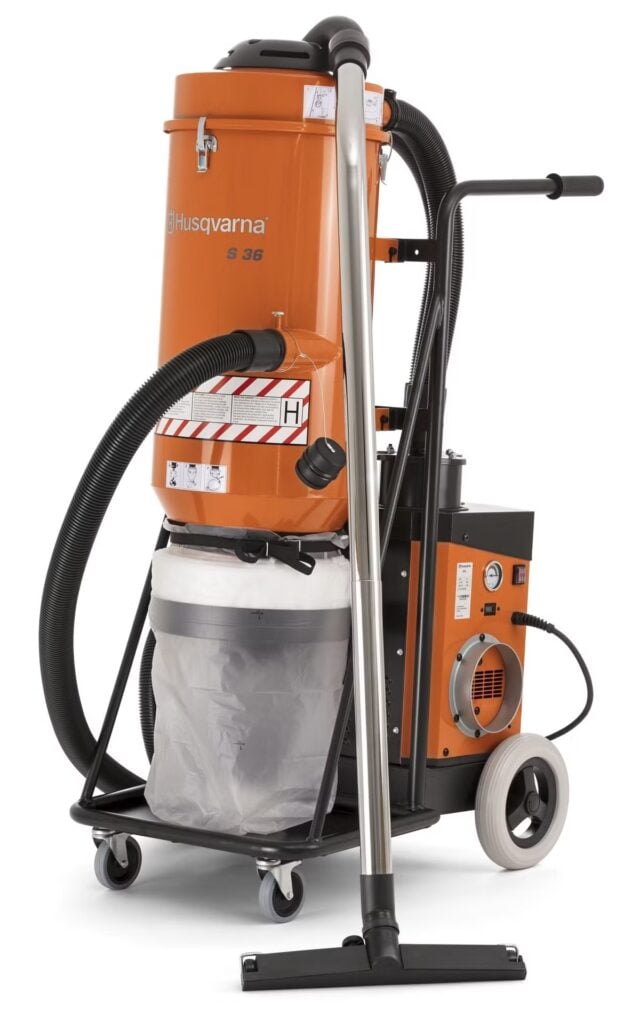
- Power: 10.2 HP motor, 285 CFM airflow
- Filter: Two HEPA filters, 99.99% efficient at 0.3 microns
- Housing: Sheet metal, steel handle & clamps
- Product Perks: 1-year product warranty
Frequently Asked Questions
WHAT MAKES A VACUUM THE BEST CONCRETE DUST COLLECTION?
The best vacuum for concrete dust combines three essential elements:
- HEPA filtration (99.97%+ efficiency)
- Sufficient CFM rating for your project size
- Durable construction to withstand industrial environments
Look for models with automatic filter cleaning and comprehensive warranties.
WHAT IS THE BEST VACUUM DUST COLLECTION SYSTEM FOR CONCRETE SURFACE PREPARATION?
An effective vacuum dust collection system for concrete surface prep is one that’s built to pair well with abrasive equipment like floor grinders and polishers.
A good dust collection system will typically include the following:
- Shroud or hood recommended per the tool manufacturer
- A filter with at least 99% efficiency
- An exhaust hose with at least 1.5” diameter
- Enables easy bag change-out while minimizing dust exposure upon removal
- Enough power to collect dust from the point of abrasion
Before you hit the job site, you’ll also want to have adequate accessories handy—cords, hoses, attachments, and extra filters.
WHAT ARE THE VACUUM REQUIREMENTS FOR SILICA DUST EXTRACTION?
There are no universal standards for the type of vacuum you need to remove silica dust from your worksite because every worksite is different. However, OSHA requires that you take measures to prevent silica inhalation and recommends using a dust collection system as operated per the manufacturer’s instructions.
HOW MUCH POWER SHOULD MY INDUSTRIAL DUST COLLECTOR HAVE?
You’ll want enough dust collector power to maintain a compliant construction environment. The recommendation for power is, at the very least, that your collector produces enough suction to capture the concrete dust at the cutting (or grinding) point on the surface.
If your dust collector is set up for direct extraction with your equipment and you’re leaving behind excess dust as you work, you should consider upgrading or replacing your machine.
SHOULD I GET A PROPANE OR AN ELECTRIC DUST COLLECTOR?
As with all surface prep equipment, your dust collector power type will depend on your everyday needs. Propane is a great choice for extensive outdoor work where electrical outlets are out of reach, and electric equipment offers uninterrupted work safe from fumes – so an obvious choice for indoor or enclosed environments.
Just ensure you head out to the job site ahead of time and have the proper outlets in place.
WHAT KIND OF FILTER DO I NEED FOR CONCRETE DUST EXTRACTION?
When considering dust extraction, OSHA requires that your filter be able to remove and capture very fine dust particles at extremely high-efficiency rates. You’ll need a HEPA filter for your vacuum to collect dust at this efficiency. HEPA filters have a 99.97% rate for 0.3-micrometer diameter minimums.
WHAT IS THE BEST BRAND FOR CONCRETE DUST COLLECTION SYSTEMS?
Lift power, warranties, maneuverability, and a quality dust collection brand will offer a collector that complements your concrete surface projects. We may be biased, but the RSP brand here at Runyon delivers on all cylinders of dust collection needs.
Final Thoughts
Choosing the right industrial vacuum for concrete floors is crucial to maintaining a clean and safe work environment. Consider factors such as power, efficiency, filters, dust containment systems, and size when selecting an industrial vacuum for your specific needs.
By selecting the right vacuum, you can effectively remove dust and debris from concrete floors, creating a cleaner and safer work environment for you and your employees.