

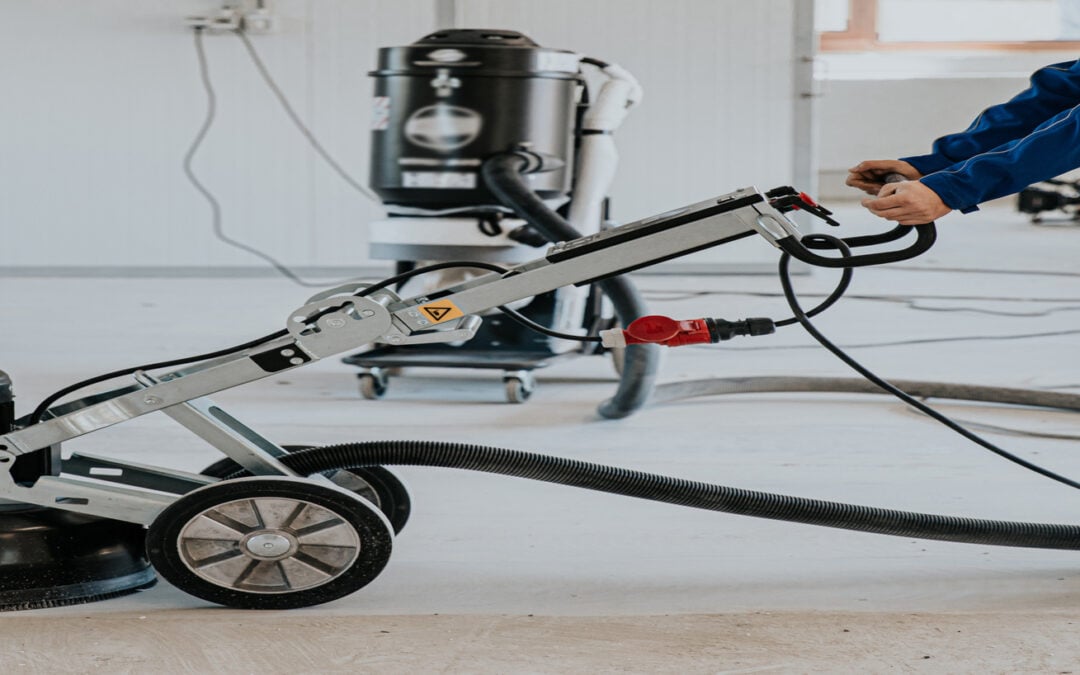
How to grind down concrete for any given project will depend on the amount of concrete you need to grind, as well as the surface texture you want to leave behind. Some projects may require a simple walk-behind floor grinder with a modest tooling grit, while others may need the abrasive removal power of a concrete scarifier.
This post aims to provide guidance on how to effectively grind your surface, taking into account the project’s penetration and finishing requirements.
What Is Concrete Grinding and When Do You Need It?
Concrete grinding is the process of using surface grinding equipment to smooth, level, or remove layers of hardened concrete. Contractors and homeowners turn to this process when they need to:
- Remove the old epoxy, paint, or adhesive coatings.
- Level uneven slabs, and eliminate any tripping hazards.
- Prepare a slab for new coatings by creating the proper concrete surface profile (CSP).
- Polish a floor for an attractive, durable finish.
Grinding is essential for both concrete surface preparation and decorative finishing. Whether you’re working on a garage floor, a public sidewalk, or a large commercial project, the right grinding approach leads to better longevity, safety, and performance.
How to Choose the Right Equipment for Grinding Concrete?
Choosing the right grinding machine depends on the scale of your project, the hardness of the concrete, and your desired finish.
Equipment Selection by Project Type
| Project Type | Equipment | Grit Range | CSP Rating | Area Coverage |
| Paint removal | Floor grinder | 30-80 | 1-2 | <5,000 sq ft |
| Leveling walkways | Concrete shaver | N/A | 3-4 | Any size |
| Epoxy prep | Scarifier | 16-40 | 4-6 | >10,000 sq ft |
| Final polish | Power trowel | 400-3000 | 0-1 | >20,000 sq ft |
| Thick coating removal | Shot blaster | N/A | 3-5 | >5,000 sq ft |
| Spot repairs | Handheld grinder | 30-120 | 1-3 | <100 sq ft |
| Heavy adhesive removal | Scarifier + Grinder | 16-80 | 4-7 | >2,000 sq ft |
| Decorative polish | Planetary grinder | 50-3000 | 0-2 | Any size |
| Trip hazard removal | Concrete shaver | N/A | 2-4 | Linear feet |
| Surface prep (thin coat) | Walk-behind grinder | 80-120 | 1-2 | <10,000 sq ft |
Additional Decision Factors
By Concrete Hardness
| Concrete PSI | Bond Type | Starting Grit |
| <3,500 (Soft) | Hard bond | 40-60 |
| 3,500-5,000 (Medium) | Medium bond | 30-40 |
| >5,000 (Hard) | Soft bond | 16-30 |
By Removal Depth
| Removal Depth | Primary Equipment | Secondary Equipment |
| Surface only (<1/32″) | Floor grinder | Handheld grinder for edges |
| Light (1/32″ – 1/8″) | Floor grinder or scarifier | Shot blaster for speed |
| Medium (1/8″ – 1/4″) | Scarifier | Grinder for finishing |
| Heavy (>1/4″) | Concrete shaver | Scarifier for texture |
Coverage Rates by Equipment Type
| Equipment Type | Sq Ft/Hour | Operator Skill Required |
| Handheld grinder | 20-50 | Low |
| Walk-behind grinder | 200-400 | Medium |
| Ride-on grinder | 1,000-2,000 | High |
| Scarifier | 350-750 | Medium |
| Shot blaster | 500-1,500 | High |
| Concrete shaver | 100-300 linear ft | Medium |
| Power trowel (polish) | 2,000-4,000 | High |
- For small areas or spot work, a handheld grinder is sufficient.
- In medium projects, a walk-behind floor grinder offers better productivity.
- If you need heavy removal, a scarifier or shaver is more effective.
- For polishing jobs, planetary grinders or power trowels provide consistent results.
Runyon Surface Prep provides rental and purchase options, helping contractors match equipment to project goals.
GRINDING DOWN COATED & FINISHED CONCRETE
There are a few ways you can grind down and remove layers of concrete coating and sealers.
- Floor grinder: to strip the topmost coat, whether that’s an epoxy overlay or a layer of paint.
- Concrete scarifier: to remove concrete coats with the purpose of also leveling or texturizing
- Shot blaster: to remove deeper layers of surface coats or otherwise covered concrete
There are also chemicals you can use to remove the concrete coating, though that would involve a different approach not covered in this article.
When dealing with coatings, start with diamond grinding pads that match the hardness of your slab. Using the wrong grit can leave swirl marks or require unnecessary passes. Contractors often combine mechanical removal with dust control systems to maintain safe air quality.
PREPARING FOR A NEW COAT
Some concrete professionals grind surfaces to prepare them for a new coat. The roughness or texture of the surface will determine its compatibility for coating, as measured by the concrete surface profile (CSP). If you plan to use a basic sealer, you’ll want a CSP of 1 to 2 (0 to 0.75mm).
To leave a rougher texture for a higher CSP, use a concrete scarifier. For a lower texture CSP, a planetary floor grinder with diamond tooling will do fine.
Proper surface prep prevents problems that occur when coatings are applied to smooth or contaminated surfaces. Using the right tooling means that adhesives bond correctly. Runyon offers a full line of grinders and scarifiers for every CSP rating.
LEVELING OUT CONCRETE
Public municipalities and commercial building owners alike know the struggle of maintaining pathway compliance for the public. When walkways have a discontinuity (or uneven concrete slabs) of more than one-half inch (vertically), the United States federal government requires repair or leveling.
The most efficient way to make a compliant walkway is with a concrete shaver. Runyon currently carries concrete shavers in propane or electric options. A shaver uses a rotating drum cutter to remove layers of concrete with precision, thereby leveling unlevel slabs.
If you don’t have a shaver, we offer them for rent. Minor bumps or very fine discontinuities can be ground down with a traditional floor grinder. Other concrete leveling tools (like handheld grinders with cup wheels) work well for smaller trip hazards.
For large-scale projects, renting heavy-duty shavers or scarifiers will allow you to meet ADA compliance efficiently.
GENERAL POLISHING
If you’re simply looking for a good polish, you have two equipment options: a floor grinder or a power trowel adapted for diamond tool polishing.
FLOOR GRINDER
Planetary floor grinders vary in power and coverage. They also vary in power type, available in propane and electric versions. Floor grinders are a contractor’s best friend. They make a great long-term investment for the everyday surface prepper, or a great one-off rental tool for the concrete construction worker looking for a quick polish.
Start the concrete polishing process with coarse grit diamond tools and progress to finer grits for a glossy finish. The final result is a low-maintenance floor that resists dusting and staining. For larger projects, renting a floor grinder is often the most cost-effective solution.
POWER TROWEL
Traditionally used for troweling concrete and removing moisture for best curing, innovative engineers have now made it possible for power trowels to also polish concrete for very basic top-layer grinds.
Power trowel polishing is ideal for expansive warehouse floors where production speed matters more than mirror-like clarity. Ride-on power trowels may be fitted with RSP’s magnetic preload system, which allows for an easy tooling switch-out for varying grits.
Step-by-Step Guide: How to Grind Down Concrete Floors
Grinding concrete requires a systematic approach to achieve consistent results. Follow these steps to complete the process efficiently and safely.
- Inspect the surface – Check for coatings, cracks, or uneven areas.
- Select equipment and tooling – Match the grinder and pads to your slab’s hardness.
- Set up dust control – Connect vacuums or dust shrouds for safe air quality.
- Make initial passes – Start with a coarse grit for removal or leveling.
- Progress through grits – Work to finer grits for a smoother finish.
- Check flatness – Use straightedges or laser levels for accuracy.
- Apply sealer or polish – Finish with protection for durability.
This workflow shows how to grind down concrete in residential garages, retail spaces, and industrial warehouses while achieving consistent results.
Different Grinding Techniques for Various Concrete Types
Grinding techniques must be adjusted to match the condition and hardness of the concrete. For soft concrete, contractors often use harder bond tooling to avoid premature wear of the diamond segments. In contrast, hard concrete requires softer bond pads, which cut more effectively and prevent glazing on the surface.
When dealing with old or weathered slabs, aggressive scarifiers may be necessary for the initial removal phase before switching to finer equipment. Decorative concrete requires a more nuanced approach; using fine-grit pads will yield a refined surface that avoids damaging decorative finishes.
Concrete grinding techniques vary based on whether the goal is removal, preparation, or polishing. For example, terrazzo grinding and polishing require their own set of tools.
Safety Precautions and Protective Equipment Required
Grinding concrete floors can be hazardous if proper precautions aren’t taken. The process generates silica dust, produces loud noise, and exposes workers to vibration and flying debris.
Safety must be prioritized by using the right protective equipment. Always wear:
- Safety glasses or face shields.
- Hearing protection.
- Dust masks or respirators rated for silica.
- Gloves and steel-toe boots.
Runyon also supplies dust control vacuums and shrouds to help contractors meet OSHA silica compliance.
Taking the time to properly gear up prevents long-term health issues and improves productivity. Workers can focus on achieving a precise finish without interruptions caused by unsafe conditions. Safety is the foundation of every successful concrete grinding project.
How Much Does It Cost to Grind Concrete? (DIY vs Professional)
The cost of grinding concrete depends largely on whether you choose a do-it-yourself approach or hire a professional.
For DIY projects, the primary expense is equipment, as renting a grinder can run several hundred dollars per day, plus added costs for diamond tooling. This option often makes sense for small areas where labor is manageable and the finish does not need to be highly polished.
DIY Cost Breakdown (1,000 sq ft garage)
- Equipment rental: $300-450/day
- Diamond tooling set: $150-200
- Dust control system: $100/day
- Safety equipment: $75
- Total: $625-825
On the other hand, professional grinding services typically charge between $3 and $8 per square foot, depending on the level of finish required. While this is more expensive upfront, contractors bring specialized equipment, efficiency, and proven concrete removal methods, which often make them the better choice for large or complex jobs.
Professional Cost Variables
- Basic grind (CSP 1-2): $3-4/sq ft
- Heavy removal (CSP 4-6): $5-7/sq ft
- Polished finish: $6-8/sq ft
- Minimum charge: typically $500-1,000
Common Mistakes to Avoid When Grinding Concrete
Even experienced contractors can run into problems when grinding concrete if the process is rushed or equipment is misused. One of the most common issues is starting with the wrong grit sequence, which can leave scratches that require additional passes to correct.
Dust control is another common oversight. Skipping vacuums or shrouds creates unsafe working conditions, and when visibility is compromised, it slows down progress. Applying excessive pressure causes uneven wear on tooling and leads to inconsistent finishes.
Tooling should also be inspected regularly; worn segments reduce efficiency and can damage the surface. Edge grinding is often forgotten as well, leaving visible differences between open areas and walls or columns.
Another frequent mistake is ignoring moisture issues. Trapped moisture beneath coatings leads to delamination and failure, which is why every slab should be tested before applying sealers.
Equipment Rental vs Purchase: Making the Right Choice
For one-time or small projects, renting a floor grinder is usually the most economical choice. Renting provides access to high-quality machines without the upfront investment.
However, for professionals who handle grinding and polishing jobs regularly, purchasing equipment pays off quickly by reducing long-term costs and keeping tools available when needed.